The Rise of Purposeful Publishing: Why Tools Like Elementary Notebook KDP Interior Matter Now
In a world saturated with digital noise, the act of creating something tangible and personal has taken on a renewed significance. This isn't just nostalgia; it's a deliberate counter-movement. Professionals, creators, and entrepreneurs are increasingly seeking tools that bridge digital convenience with physical craft. In this landscape, purpose-built publishing assets, such as the Elementary Notebook - KDP Interior, have moved from being mere utilities to becoming essential components of a modern creative workflow.
Beyond Blank Pages: Defining the KDP Interior
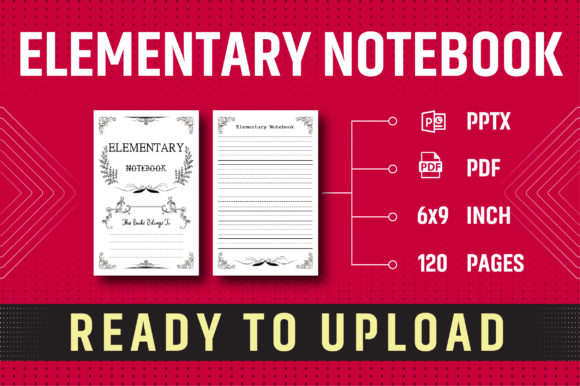
At its core, an "Elementary Notebook - KDP Interior" is a pre-designed, fully formatted template file engineered specifically for Amazon's Kindle Direct Publishing (KDP) platform. It is a complete, ready-to-print interior layout for a notebook or journal. The phrase "This is a ready-to-upload file. We will provide a Ready PDF file of 120 Pages, Size '6x9 Inch', No Bleed" speaks directly to its practical essence. It eliminates the technical hurdles of page setup, margin calibration, and file formatting, delivering a polished, professional-grade base product. This includes well-designed "Belongs To" pages and other structural elements, allowing the creator to focus entirely on content, customization, and branding.
The Engine of Empowerment: From Barrier to Gateway
The true value of a resource like the Elementary Notebook KDP Interior lies in its function as an empowerment tool. Historically, self-publishing a physical notebook required significant design skill or the budget to hire a graphic designer. Now, a marketer wanting to create a branded workbook for a client workshop, a freelancer publishing a niche planner for their industry, or an enthusiast compiling a specialized journal can start from a position of strength. The editable PPTX file mentioned underscores this shift. It provides a familiar, accessible environment (Microsoft PowerPoint) for customization, making the transition from idea to product fluid and less technically intimidating.
Alignment with Macro Trends: The Convergence of Creativity, Commerce, and Customization
The relevance of these tools is inextricably linked to several converging trends.
- The Professionalization of Passion Projects: The line between hobby and micro-business has blurred. Enthusiasts are no longer just making things for themselves; they are publishing, selling, and building communities around their niches. A ready-to-use KDP interior transforms a personal project into a viable, market-ready product with minimal overhead.
- The Demand for Bespoke Physical Products: Despite our digital lives, there is a growing market for high-quality, thoughtfully designed physical goods. Notebooks, planners, and journals are no longer generic commodities. They are tailored to specific interests, professions, and lifestyles (e.g., coding journals, mindfulness trackers, project management logs). A customizable interior template is the first critical step in serving this demand.
- The Efficiency-Centric Creative Workflow: Modern creators operate at the intersection of art and efficiency. They seek to optimize every stage of production. Spending weeks learning PDF bleed settings or wrestling with layout software is an inefficient use of creative capital. Tools like the Elementary Notebook KDP Interior compress the technical phase, freeing up time for the actual creative work—the content, the unique design touches, and the marketing.
Why Attention is Focusing on Publishing Tools
The attention paid to specific KDP interiors isn't about the template itself, but about what it represents: a lowered barrier to quality. As the self-publishing market matures, consumer expectations rise. A poorly formatted interior with misaligned margins or amateurish design can undermine even excellent content. Creators are now acutely aware that product presentation is a direct component of brand credibility. Therefore, they are actively seeking assets that guarantee a baseline of professional presentation, allowing them to compete alongside traditionally published goods. The specificity of the description—120 pages, 6x9 inch, no bleed—provides certainty, a crucial factor for professionals who need to manage project scope and output reliably.
Changing Needs and the Shift from DIY to DIFM (Do-It-For-Me)
The evolution in creator needs is telling. The early days of self-publishing were dominated by a "Do-It-All-Yourself" (DIY) mentality, often leading to inconsistent results and burnout. The current preference leans toward a hybrid model: "Do-It-For-Me" (DIFM) on the foundational, repetitive tasks, and "Do-It-Yourself" on the unique, value-added customization. This is exactly the role a pre-designed KDP interior fulfills. It provides the "for-me" component—the perfected technical structure—while the editable file enables the "yourself" component—the infusion of personal style, logos, color schemes, and specialized content.
Practical Observations and the Larger Development of Platform Ecosystems
Observing how these tools are used reveals their practical impact. An entrepreneur might use the Elementary Notebook KDP Interior to rapidly prototype a workbook for a new coaching program, testing market response with a physical product before investing in large-scale printing. A community manager might customize it to create a members-only journal, adding tangible value to a digital subscription. These applications connect to a larger development: the maturation of platform ecosystems like Amazon KDP. The platform provides the distribution and printing (Print-on-Demand), while the ancillary market of professional templates provides the quality ingress point. This symbiotic relationship elevates the entire ecosystem's output.
The inclusion of instructions like "Note: You have to collect and install the fonts to get the same design" is also a significant, often overlooked, detail. It subtly educates the user on a key professional practice—font licensing and consistency—further elevating their final product and design acumen.
Conclusion: Tools as Catalysts for Creative Output
Ultimately, the discussion around specific publishing tools like the Elementary Notebook KDP Interior is a discussion about enabling meaningful creation in a competitive landscape. It is a response to the modern creator's need for speed, quality, and focus. By handling the complexities of formatting and providing a springboard for customization, these tools catalyze the transformation of ideas into objects. They signify a shift where the act of publishing is no longer gatekept by technical expertise, but is open to anyone with insight, content, and a vision for serving a specific audience with a purposeful, well-crafted physical product. This alignment with broader trends of professionalized passion, bespoke goods, and efficient creativity ensures that such resources will remain not just relevant, but vital, in the toolkit of today's producers and publishers.