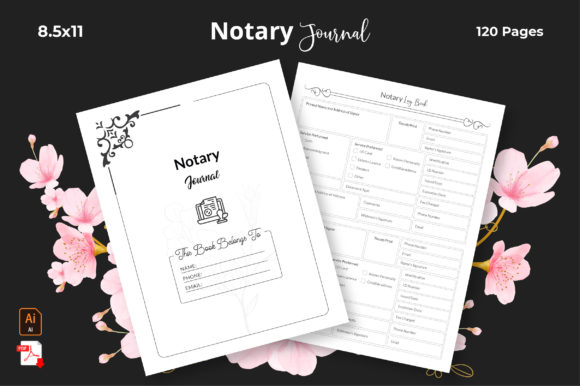
Understanding the Notary Records Journal – KDP Interior for Your Publishing Venture
For entrepreneurs exploring the low-content and no-content book market on Amazon's Kindle Direct Publishing (KDP) platform, sourcing reliable and properly formatted interiors is a fundamental step. Among the various resources available, the Notary Records Journal - KDP Interior represents a specific, practical offering. This article examines its features, considers its place within the broader ecosystem of KDP resources, and explores the decision factors involved in choosing such a product for your business.
What Is the Notary Records Journal – KDP Interior?
The Notary Records Journal - KDP Interior is a pre-designed, digital file set intended for creators who wish to publish a bound journal tailored for notary public professionals. Its core purpose is to serve as the complete interior layout of a physical book, ready for integration with a cover design and upload to KDP. The product is defined by its specifications: a standard US size of 8.5″ x 11″ inches, 120 pages, and delivery in multiple file formats including JPEG, PDF, and editable Adobe Illustrator files. This combination aims to provide both a ready-to-print solution and flexibility for customization.
What makes this offering distinct is its focus on a niche professional tool—a notary record journal—combined with the specific requirements of KDP publishing. It is not merely a generic journal template; it is formatted with the structured pages one would expect in a formal record-keeping log for notarial acts, making it a specialized interior compared to blank or themed journals.
Key Features and Practical Considerations
Evaluating the Notary Records Journal - KDP Interior involves looking at its stated attributes and how they translate into real-world use for a publisher.
File Formats and Customization Potential
The provision of JPEG, PDF, and editable Adobe Illustrator files addresses different user needs and skill levels. The PDF and JPEG files are typically considered the "ready for upload" options. They allow a publisher with minimal design experience to quickly assemble a book by adding a cover. The inclusion of editable Illustrator files, however, is a significant point for those with graphic design skills or access to a designer. It enables deep customization of the layout, fonts, and page structure, potentially allowing a publisher to differentiate their final product from others using the same base template.
The tradeoff here is clear. Using the pre-formatted JPEG or PDF offers speed and convenience, accepting the design as-is. Utilizing the Illustrator files for customization requires time, expertise, and software, but can lead to a more unique product. This dual-format approach is a notable strength, as it caters to both the efficiency-focused entrepreneur and the customization-focused publisher.
Page Count and Dimensions
The 120-page count at 8.5″ x 11″ inches is a standard, professional size. This dimension is common for workbooks, logs, and professional journals, lending the final printed book a substantive feel. When comparing options, some interiors offer fewer pages (e.g., 100 pages) for a lower-cost production, while others might offer more (e.g., 200 pages) for a perceived higher value. The 120-page length strikes a balance, potentially keeping printing costs manageable while providing ample space for record entries. Publishers should consider their target audience's expectations: a busy notary might prefer a compact log, while an office might desire a more voluminous annual record. The chosen page count here is a middle-ground solution.
Comparing It to Alternative KDP Interior Resources
When researching KDP interiors, creators encounter a wide spectrum of options. Understanding where the Notary Records Journal - KDP Interior fits can help in making an informed selection.
Specialized Niches Versus Generic Templates
A major comparison point is between niche-specific interiors like this notary journal and more generic blank journal or notebook interiors. Generic templates are highly versatile; they can be marketed for a multitude of purposes—from student notebooks to personal diaries. Their strength is in their broad applicability. The Notary Records Journal - KDP Interior, however, serves a specific professional niche. This specialization can be a powerful advantage in marketing, as it immediately communicates utility and relevance to a defined customer group (notaries). The limitation, conversely, is a narrower potential market. If your business strategy involves targeting professional niches, this interior is a strong candidate. If you prefer to test multiple broad ideas with the same interior template, a generic option might offer more flexibility.
Level of Completeness and Required Input
Some KDP interiors are sold as fully "done-for-you" products where you simply add a cover title. Others are basic skeletons requiring significant layout work. This product appears to occupy a middle position. The provided PDF is complete and tested for KDP, suggesting it should pass KDP's automated review process for interior files, which is a crucial practical benefit. The "100 customizable" claim associated with the editable files indicates a base structure that can be altered. This contrasts with interiors that are purely static images and with those that are merely collections of individual page elements you must assemble yourself. For publishers wary of technical rejection from KDP, the pre-tested completeness is a meaningful factor.
Decision Factors: When Is This the Right Choice?
Choosing any publishing resource depends on your business goals, skills, and target market. Let's explore scenarios where this interior is a good fit and where you might consider another path.
Best-Fit Situations for the Notary Records Journal Interior
- You are targeting the professional notary market. If your research or existing business focuses on serving notaries public, law offices, or administrative professionals, this specialized interior directly aligns with that need. Its pre-formatted record pages save you the time of designing a functional layout from scratch.
- You value a balance of convenience and customization potential. Having both ready-to-upload files and editable source files allows you to start quickly and potentially iterate later. This is useful if you plan to release multiple versions or brands within the same niche.
- You prioritize avoiding KDP technical issues. The assurance that the interior is "formatted and tested for KDP" can reduce the risk of upload errors and rejection, which is valuable for new publishers or those optimizing their workflow efficiency.
When You Might Need a Different Option
- If your business model is based on extreme low-cost entry. While this interior offers value, there are often free or lower-cost generic templates available. If your primary goal is to test the KDP market with minimal initial investment, a simpler, cheaper blank journal interior might be a starting point.
- If you require a different page size or count. The 8.5″ x 11″ inches and 120 pages are fixed. Some markets, perhaps for portable notary kits, might prefer a smaller 6″ x 9″ inches journal. If your customer analysis points to a different physical specification, you would need to seek an interior with those exact dimensions.
- If you possess advanced design skills and seek a unique design from the ground up. For publishers who wish to build a highly distinctive brand identity, starting with an editable template might still involve more adaptation than desired. In such cases, creating a completely original interior or hiring a designer for a bespoke layout could be the better long-term strategy, despite the higher upfront cost and time.
Evaluating the Overall Value and Tradeoffs
The practical value of the Notary Records Journal - KDP Interior hinges on its niche specialization and multi-format delivery. Its main tradeoff is between the focused utility it provides and the broader, but less targeted, utility of a generic template. For a publisher committed to the professional niche, the specialization is not a limitation but a core benefit. The 120-page length is a standard offering; publishers should weigh whether this matches their perceived customer value expectation versus a higher-page-count product that might command a higher retail price but also incur higher printing costs.
A realistic example: Imagine two KDP entrepreneurs. One, Sarah, quickly wants to publish a range of journals for various professions, including notaries. She might find a generic log template and adapt it herself for several uses, saving per-product cost but spending more time on each adaptation. Another, David, is building a brand solely around legal and administrative professional tools. For him, the Notary Records Journal - KDP Interior is an efficient, credible starting point that he can potentially customize later with his brand colors using the Illustrator files. His path is more streamlined for his specific goal.
Ultimately, the choice involves mapping the product's features against your own resources, market focus, and willingness to customize. By understanding its distinct position as a pre-formatted, niche-specific interior with customization avenues, you can better determine if it aligns with your publishing strategy or if exploring alternative resources is the more prudent step for your particular venture.