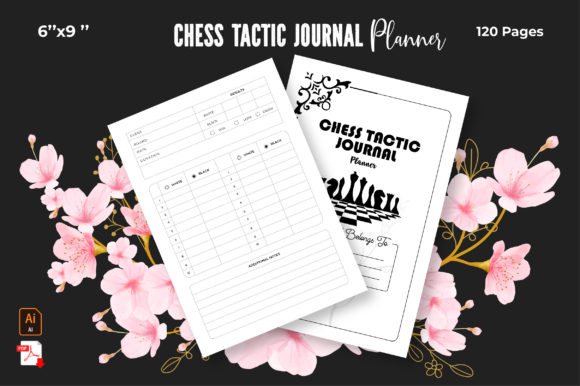
The Chess Tactic Journal: Your Blueprint for Strategic Growth
In the intricate world of chess, every game tells a story. It's a narrative of strategy, foresight, and, often, a critical mistake that changes the course of the battle. While digital platforms and apps offer swift gameplay, there's a timeless tool that fosters deeper understanding: the chess journal. More than just a notebook, a dedicated Chess Tactic Journal is a structured training ground for the mind. For entrepreneurs and creators, a ready-made journal interior designed for KDP (Amazon's Kindle Direct Publishing) presents a unique opportunity to support this intellectual pursuit while building a thriving low-content business.
The Power of Recording Your Chess Journey
Chess is not merely about moving pieces; it's about pattern recognition, calculation, and learning from every decision. Without reflection, improvement is haphazard. A Chess Tactic Journal serves as a personalized database of your encounters. By systematically recording games, analyzing pivotal tactics, and noting recurring mistakes, you transform passive playing into active learning. This practice embeds strategic principles deeper into your cognitive framework, making complex future calculations more intuitive.
What Goes Into a Chess Journal?
A well-designed journal provides guided prompts to structure your analysis. Typical sections include:
- Game Log: Date, opponent, result, and key observations from the overall match.
- Tactic Spotlight: A dedicated space to draw or describe a specific tactical moment (like a fork, pin, or skewer) that occurred, explaining why it worked or failed.
- Position Analysis: Blank chessboards for sketching critical positions to study them without the pressure of an ongoing game.
- Lesson Learned: A summary section to crystallize the core strategic insight from a session.
- Opening & Endgame Repertoire: Pages to track your preferred opening moves and common endgame patterns you are practicing.
The Modern Solution: KDP Chess Tactic Journal Interiors
For those looking to create and share such a tool without design expertise, pre-made KDP interiors are a game-changer. These are professional, print-ready digital files specifically formatted for Amazon's self-publishing platform. A product like the Chess Tactic Journal - KDP Interior Download offers a complete, hassle-free solution.
Key Specifications and Benefits
Consider a typical offering: a 6" x 9" journal, 120 pages, provided in JPEG, PDF, and editable Adobe Illustrator files. These specifications are carefully chosen. The 6" x 9" size is a popular, reader-friendly paperback dimension. 120 pages provides substantial depth for months of analysis without being overwhelming. The multiple file types cater to different user needs:
- PDF & JPEG: For immediate, ready-to-upload publishing. They are pre-formatted and tested to meet KDP's strict printing requirements, ensuring your upload process is smooth.
- Editable Adobe Illustrator Files: For customization. This is crucial. You can add your own branding, adjust page layouts, or even translate text to cater to specific markets, making the product uniquely yours.
The "100 formatted and tested" promise addresses a major pain point for new publishers: technical rejection. Amazon KDP has precise guidelines for bleed, margins, and resolution. A pre-tested interior eliminates that risk, turning a complex process into a simple upload.
Fitting into Modern Life: Education, Business, and Mindfulness
This concept bridges several contemporary domains.
Educational Tool
For students, coaches, or self-taught enthusiasts, the journal embodies active learning pedagogy. It slows down the digital, fast-paced gaming experience, encouraging metacognition—thinking about one's thinking. This is invaluable for cognitive development, applicable far beyond chess.
The Low-Content Business Opportunity
The rise of KDP has democratized publishing. "Low-content" books, like journals, planners, and logbooks, fulfill specific needs without requiring extensive writing. For entrepreneurs, they represent a scalable business model with low overhead. A niche, functional product like a chess tactic journal taps into a dedicated community. By providing a high-quality, tested interior, you bypass the design and technical hurdles, focusing instead on marketing and reaching the right audience on platforms like Amazon.
A Practice in Mindfulness and Discipline
In a distracted world, sitting down with a physical journal to analyze a chess game is a deliberate act of focus. It cultivates patience and disciplined review, skills transferable to professional work and personal projects. The tactile experience of writing and drawing can also enhance memory and engagement compared to purely digital note-taking.
Clarifying Common Misunderstandings
Several assumptions might surround such a product.
- "It's Only for Advanced Players." False. Beginners benefit most from structured reflection. Identifying a single "blunder" per game and understanding why it happened accelerates learning faster than playing dozens of unanalyzed games.
- "A Digital App Could Do This." Partly true, but the physical journal offers a curated, distraction-free space. It encourages longer, deeper analysis without notifications or the temptation to immediately start a new game.
- "KDP Interiors Are Just Templates, Not Unique Products." Misleading. While the base structure is provided, the editable files allow for significant customization. Furthermore, your branding, description, and marketing make it your own product. The value is in providing a ready-made, professionally vetted solution to a problem.
Building a Broader Understanding: The Ecosystem of Strategic Tools
The Chess Tactic Journal isn't an isolated tool. It fits into a broader ecosystem of strategic improvement. Use it alongside:
- Chess Engines & Databases: Use the journal to note positions you want to analyze later with software like Stockfish.
- Online Courses & Books: Reference specific lessons from your studies and apply them in your journaled game analyses.
- Coaching Sessions: Share your journal entries with a coach to provide concrete examples of your thought process, making feedback more targeted.
This integrated approach turns the journal into the central hub of your training regimen, connecting disparate learning resources.
An Example in Practice
Imagine you lose a game because you missed a knight fork attacking your king and queen. In your journal, you sketch that critical position. You write: "Tactic: Fork. Missed because I focused only on the queen's safety and didn't scan for knight's possible moves two squares away." Next, you research common fork patterns. Weeks later, you spot a similar possibility in a game and avoid it, noting the success in your journal. This cyclical process—record, analyze, study, apply—is the engine of deliberate improvement.
Conclusion: A Strategic Asset for Players and Creators
A Chess Tactic Journal is more than pages in a book. It is a framework for intellectual growth, a catalyst for transforming random play into disciplined mastery. For the chess community, it offers a timeless, analog complement to digital tools. For the modern entrepreneur, a professionally designed, KDP-ready interior like the one described—with its 6" x 9" 120-page format, multiple file types, and customization options—represents a streamlined path to creating a valuable product. It meets a clear need: providing players with a structured tool to deepen their understanding, while offering publishers a tested, hassle-free asset to launch or expand their business. In both cases, it’s about building strategy, one move, and one page, at a time.