Unlock Creative Fun: The Ultimate Kids Maze Templates for Activity Books
Creating engaging content for children’s activity books is a rewarding challenge. Finding versatile, high-quality assets that can adapt to any theme or niche is often the biggest hurdle. That’s where the Kids Maze TEMPLATES - Spaghetti Style 2 package becomes an indispensable resource for designers, publishers, educators, and parents.
The Power of Theme-Free Maze Designs
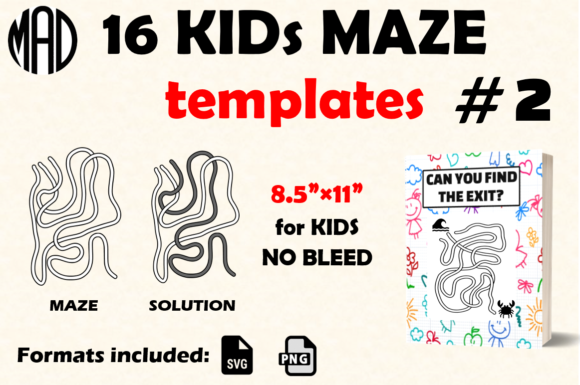
One of the standout features of this collection is its deliberate lack of a specific theme. Unlike many maze resources that are locked into a seasonal, animal, or vehicle motif, these 16 templates are pure, unadorned pathways. This blank canvas approach is a game-changer.
Imagine you’re creating an activity book about underwater exploration. You can add bubbles, fish, and seaweed to the maze lines. For a space adventure, planets and rockets become part of the journey. A fairy tale book? Castles and enchanted forests transform the path. The spaghetti-style design—with its winding, interconnected loops—provides a perfect, complex base that won’t compete with your added artwork. You maintain complete creative control to make them completely unique.
What Makes a Great Maze for Kids?
Not all mazes are created equal. A well-designed kids maze needs to balance challenge with fun, avoiding frustration. The Kids Maze TEMPLATES - Spaghetti Style 2 are crafted with key principles in mind.
- Single Correct Path: Each maze has only one valid start and end point. This eliminates confusion and provides a clear, satisfying puzzle-solving experience.
- Hand-Drawn & Unique: All 100 mazes (the package includes 16 templates, each offering multiple variations) are hand-drawn, ensuring organic, non-repetitive layouts that feel fresh and engaging.
- Appropriate Complexity: The “spaghetti” style offers a wonderful level of complexity that feels challenging but solvable, keeping young minds focused and entertained.
Practical Benefits for Your Project Workflow
Integrating these templates into your production process streamlines creation and boosts quality.
The package includes both SVG and PNG file formats. The scalable vector graphics (SVG) are perfect for professional design software like Illustrator or the free tool Inkscape. You can resize, recolor, and modify the lines without any loss of quality. The PNG files offer ready-to-use, high-resolution raster images for quick placement or simpler editing. Having both formats caters to different skill levels and software preferences.
Every maze also comes with a solution file. This is crucial for activity book creators, allowing you to verify the path, create hint pages, or even include the solutions in a parent/teacher guide. It saves you the time of solving each maze yourself to check for errors.
Beyond the Templates: The Bonus Tutorial
A truly valuable resource teaches you not just to use, but to understand and expand. The included MAZE CREATION TUTORIAL elevates this package. It explains the methodology behind the spaghetti-style design, guiding you on how to create your own using tools like Inkscape (free), PowerPoint, or Illustrator.
This empowers you to:
- Develop a deeper skill set for future projects.
- Create unlimited custom mazes tailored to extremely specific needs.
- Understand the design logic, making you better at integrating the provided templates.
It turns a template purchase into a learning opportunity, adding long-term value to your creative toolkit.
Fitting into Modern Creative and Educational Activities
Where can these mazes shine? Their application is remarkably broad.
For independent publishers and activity book creators, they are a core asset library. You can rapidly populate books for different age groups or niches without commissioning custom art for every puzzle. For educators and homeschool parents, they can be customized to complement lesson plans—a maze path shaped around historical events or scientific concepts. Bloggers and content creators offering free printables can use them to generate fresh, downloadable content regularly.
The modern workflow often demands agility and cost-effectiveness. Having a set of proven, adaptable templates like Kids Maze TEMPLATES - Spaghetti Style 2 meets that demand perfectly. You invest once in a quality resource and can repurpose it across countless projects, saving both time and money.
Considerations Before You Begin
When evaluating maze resources for your project, think about longevity and flexibility. A themed maze pack might be perfect for one book but useless for the next. These theme-free templates offer enduring value. Also consider the technical aspects: are the files provided in editable formats? Does the design allow for easy overlay of your own graphics? This package answers yes to both.
The hand-drawn uniqueness ensures the mazes don’t look generic or computer-generated, which helps your final product feel more personal and crafted. If you foresee needing more mazes over time, the creator’s suggestion to check their store for additional packs makes expanding your collection straightforward.
Making Them Unique: A Scenario
Let’s walk through a practical example. You’re making a “Gardening for Kids” activity book. You select one of the spaghetti maze SVG files and open it in Inkscape. You change the stroke color of the maze walls to a earthy brown. Then, you illustrate small flower icons along the correct path, a cute worm at the start point, and a watering can at the end. You add some decorative butterflies in the dead-end loops. Within minutes, a generic maze has become a fully integrated, thematic puzzle about finding the way to the watering can through the garden. This is the practical magic the package enables.
The Kids Maze TEMPLATES - Spaghetti Style 2 are more than just a set of puzzles. They are a creative foundation, a time-saving tool, and an educational asset. By providing the raw structure, the editable files, the solutions, and even the knowledge to create your own, they offer a comprehensive solution for anyone looking to add engaging, high-quality maze activities to their world.